
Issued by: Harry Gregory, Deputy Harbour Master
Issue date: 18 April 2019
Cancel on: Further notice
Laying of Fishing Gear off Littlehampton Harbour
MARINERS ARE ADVISED that fishing gear (such as nets and pots) is routinely laid inshore along the UK coastline including around the entrance to Littlehampton Harbour. This gear should be marked with black flags on dan buoys in line with MCA advice, however, other mariners are advised that they are normally unlit and so difficult to see at night. Fisherman are recommended to avoid laying their gear on the approaches to the harbour as this area is regularly transited by for large commercial vessels who, by night, will be unable to see markers and by day, are often also unable to avoid them given their restricted ability to manoeuvre once committed to their approach in the strong east to west tidal set.
Littlehampton Harbour aims to accommodate the diverse range of activities occurring in and around the port without imposing unreasonable restrictions but has a duty to regulate activities appropriately to ensure that the harbour and its approaches remain safe and free from hazards. Fishing gear deployed inappropriately or insufficiently marked is a cause of a significant number of complaints from ships’ Masters, Pilots and visiting yachtsmen off Littlehampton and more generally around the UK Coast. This standing local notice aims to provide a framework to allow those who fish for their livelihood or for recreation to undertake their activities in a way that does not affect the safe use of the harbour by all. Fishing Gear off Littlehampton must only be deployed and marked in line with MCA Advice to Fishermen and Yachtsmen on marking of Fishing Gear and the Fishing Boats (Marking and Documentation) (Enforcement) Order 1993. For fishermen’s own benefit, it is strongly recommended that they also follow the advice below when laying gear outside of the Harbour Limits but within the Competent Harbour Authority (CHA) Compulsory Pilotage area. The CHA area is defined in the LHB Pilotage Directions but is broadly from Elmer in the west to Ferring in the East and as far out as 3nm.
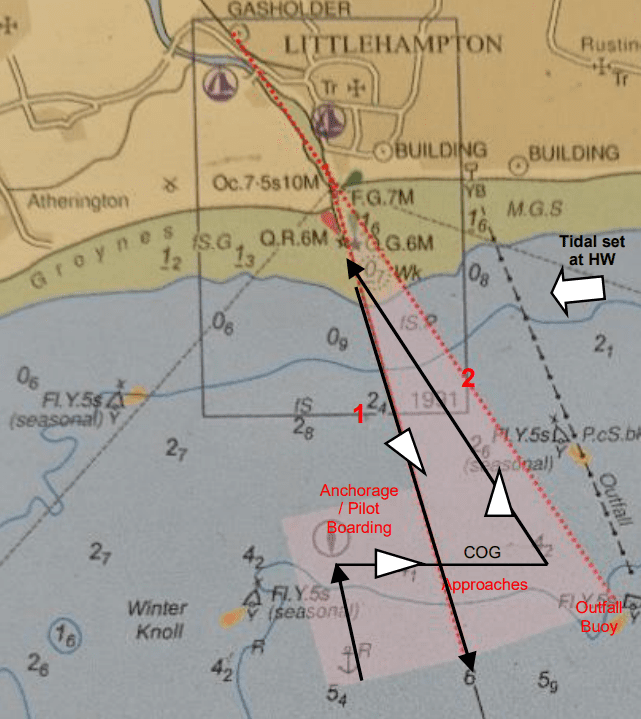
Laying of fishing gear:
- It is strongly recommended that fishermen avoid laying fishing gear in the shaded red approach area in the chart shown left (between the two red dotted Transits “1” and “2”) out to two miles from the harbour entrance.
- “Transit 1” is the charted 346° approach transit aligning the end of the East Pier (fixed green light) with the Lighthouse (occulting white light).
- Due to the east to west tidal set at high water, larger vessels generally approach from further to the east. The easterly transit used on approach is marked here as “Transit 2” which aligns the western edge of the charted Littlehampton Gas Holder with the end of the East Pier (fixed green light) and the Outfall Buoy (flashing yellow light).
- The black Course Over Ground (COG) line shows the approximate route of most commercial shipping visitors.
- The anchorage and pilot boarding area marked on all charts should similarly be avoided when laying gear.
Collisions or near misses: When a vessel under pilotage by a Master holding a Pilot Exemption Certificate or under the guidance of an authorised LHB Pilot has been in a collision or near miss with any vessel or structure within the CHA area, the occurrence shall be reported to the Harbour Master as soon possible. It shall be the responsibility of the Harbour Master to ascertain facts and, where possible, take statements from witnesses or persons involved. Where damage is caused to third parties, the Harbour Master will inform owners of craft or property of such damages where they can be identified. Where there is a risk of subsequent damage or further incident the Harbour Master will take such action as is necessary to minimise such risk (such as the introduction of this new standing local notice to improve awareness on both sides).
Advance warning of commercial shipping movements: This can be obtained by telephone (01903 721 215) or via the LHB website www.littlehampton.org.uk or on Facebook (@LittlehamptonHarbourBoard). Timings for movements are posted as soon as confirmed but may not reflect short notice changes. Fishermen intending to lay gear on or near the harbour’s approaches should ensure that they are aware of any movements programmed for this area and that their gear does not become an obstruction. All large commercial vessels enter or depart the harbour at high water. Securite port traffic broadcasts will be made on VHF 71, 15 to 30 mins before, during and shortly after the shipping movement itself.
Marking of fishing gear:
- Fishing Gear should be clearly marked for all states of visibility and tide with appropriate buoys and flags at either end of a line of pots.
- Action should be taken to avoid the dangerous practice of lines floating on or near the surface.
- There should be generous use of fluorescent strips and two bands of retro reflective tape. It is
recommended that a minimum size of a 1 metre (40 inch) circumference high visibility buoy be used at the other end of a line of marked pots. - The black flags on buoys must also be marked with the registration of the commercial fishing vessel to which they belong (e.g. LI 1234). For any non-commercial fishing vessels which may be unregistered, gear should be marked with the owner’s name and contact telephone number.
- Marking must also comply with any local marking requirements, laid down by Sea Fisheries
Committees (incl. Sussex IFCA), Harbour Authorities (incl. Littlehampton Harbour Board) and other Devolved Administrations. - Marking guidance for nets is also available in the MCA Advice on marking of Fishing Gear notice.

Advice to small vessels: Skippers must keep a sharp lookout for fishing gear, especially when navigating around headlands and harbour entrances. Yachts and other craft departing from or arriving at the harbour entrance should keep as close a lookout for fishing gear as for divers and swimmers, and can normally obtain information from the Harbour Office on the places where fishing gear is most likely to be encountered, as incidents of snagging do occur even when gear is clearly marked. If fishing gear is spotted, it is necessary to keep well clear as the wind and tide may drive a vessel onto it. It may also be a sign that there is more gear in the vicinity. It is also important to be aware that fishing gear is frequently marked at both ends. Buoys can be used to determine the rate and set of the tide, which will assist with the decision which side to pass. It is very unwise to try to pass between a marker and float. Although gear may have been set carefully, it nevertheless may be that on occasions at high tide a buoy is under the surface of the water, and at low tide slack lines may be near the surface


